Not all people with a disability want to play tennis, basketball or do athletics. New to Australia, adaptive boxing is giving athletes with a disability the chance to compete in the sport they love, or just keep fit.
To be taken from the ring in a wheelchair is a worst-case scenario for a boxer. But tonight, two boxers are entering the ring to fight in wheelchairs. Both combatants, Phil ‘The Boxing Yak’ Hulands and his opponent, Eddie Buttimore, can weight bear for long enough to slide themselves under the bottom rope at Port Melbourne’s Boxing Fit gym. Then, with Queen’s ‘We Will Rock You’ blaring, their coaches help them into their chairs where they’re strapped securely. They don headgear and mouthguards, along with pairs of 16-ounce gloves, boxing’s thickest.
The ring announcer tells the two-hundred-strong crowd that Phil is fighting out of Complete Health Geelong and that Eddie has come all the way from the Gold Coast hinterland for tonight’s contest. The fighters, set for Australia’s biggest-ever ‘adaptive boxing’ bout, are pushed to centre ring where their knees touch. The referee points below their waistbands and reminds them he wants no low blows. The boxers touch gloves, they’re wheeled back to their corners and the bell rings. Their coaches bring them back to centre ring where it’s chins down and guards up.
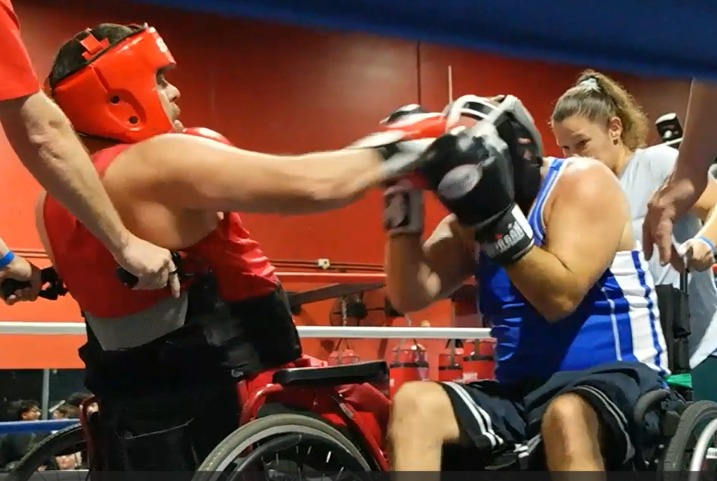
Their coaches hold them in position and Eddie and Phil are quickly down to their work, throwing the full range of punches while ducking, weaving and defending. They do everything that boxers usually do – except move around the ring. But twice during the round the pair are moved to one side of each other and the fight continues at a different angle.
Phil and Eddie have waited years for these three, three-minute rounds. They swing hooks and straight punches; they suck in deep breaths. They push themselves hard in this moment under the bright lights, their chance to show that disability hasn’t switched off their desire to stay fit, be competitive or perform at their best.
The bell rings to end round one and the fighters get a big round of applause. They’re wheeled to their corners for water, their coaches offer instructions, and they get themselves ready for the challenge of round two, just another in the many they’ve faced over the past two decades.
Phil’s a man who won’t quit
Phil was diagnosedwith Bechet’s disease in 2007, only the fourth Australian to suffer the affliction. Known as ‘the Silk Road Disease’ because it’s common in the Middle East, near the Mediterranean Sea and parts of Asia, it attacks the body with ulcers. In Phil’s case, they caused him to lose most of the mobility in his right leg. He can stand for a while with something to lean against – and walk briefly with assistance – but he spends most of his time in a wheelchair.
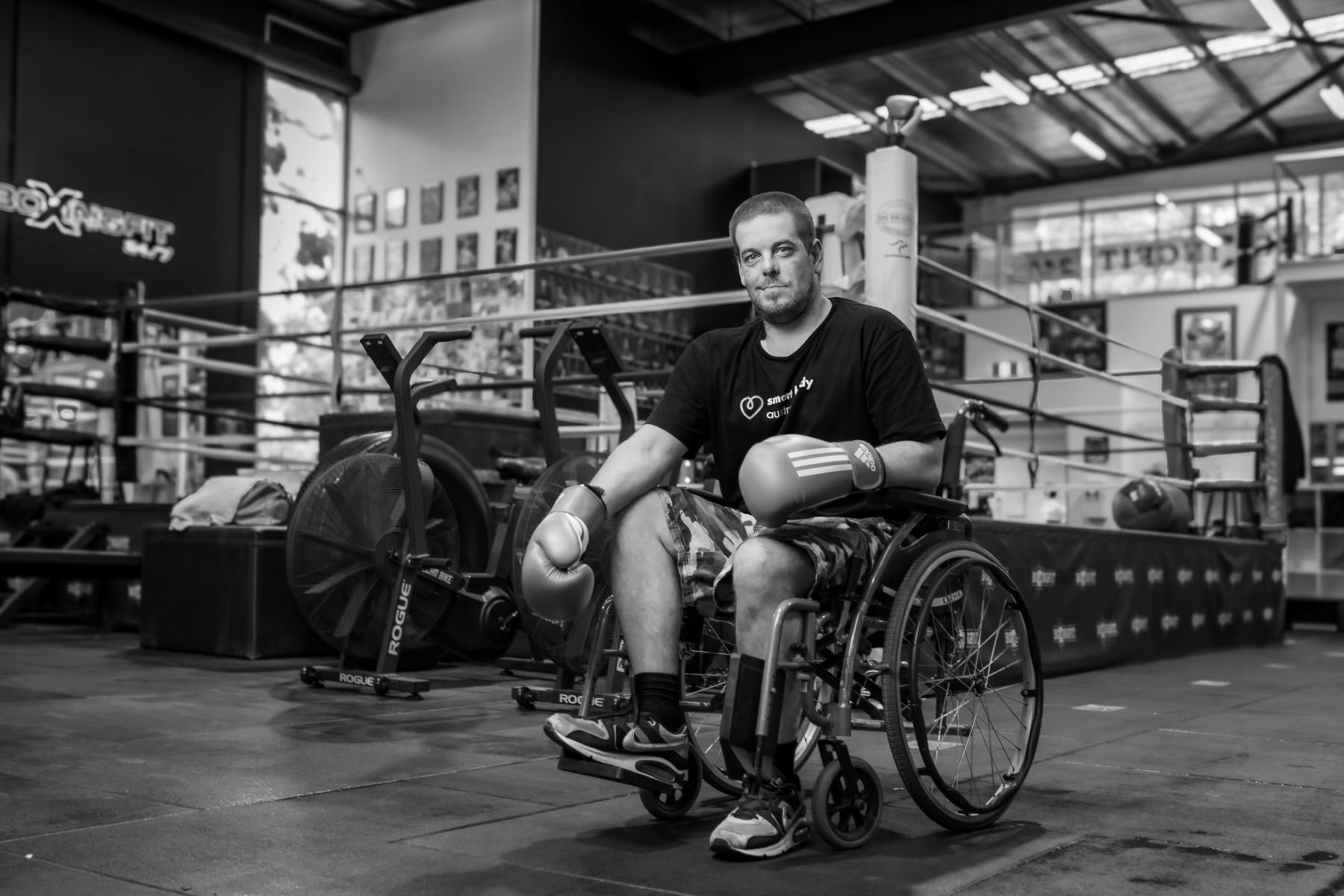
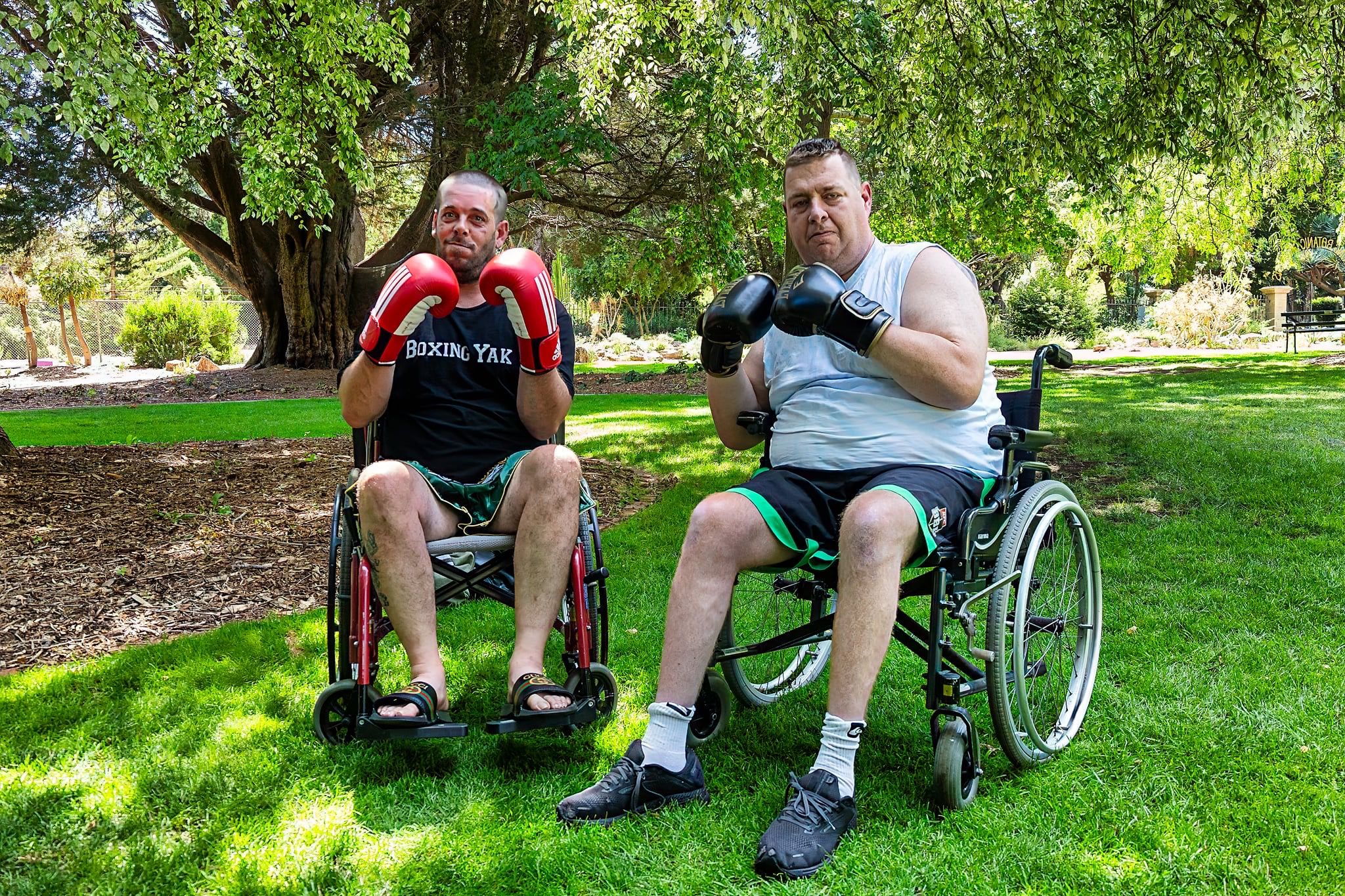
“When I first joined up at Complete Health Geelong [CHG], I was doing more cardio, none of this boxing,” Phil said when I met him a few weeks before the fight. “I was on the ski erg and doing all this physio stuff.”
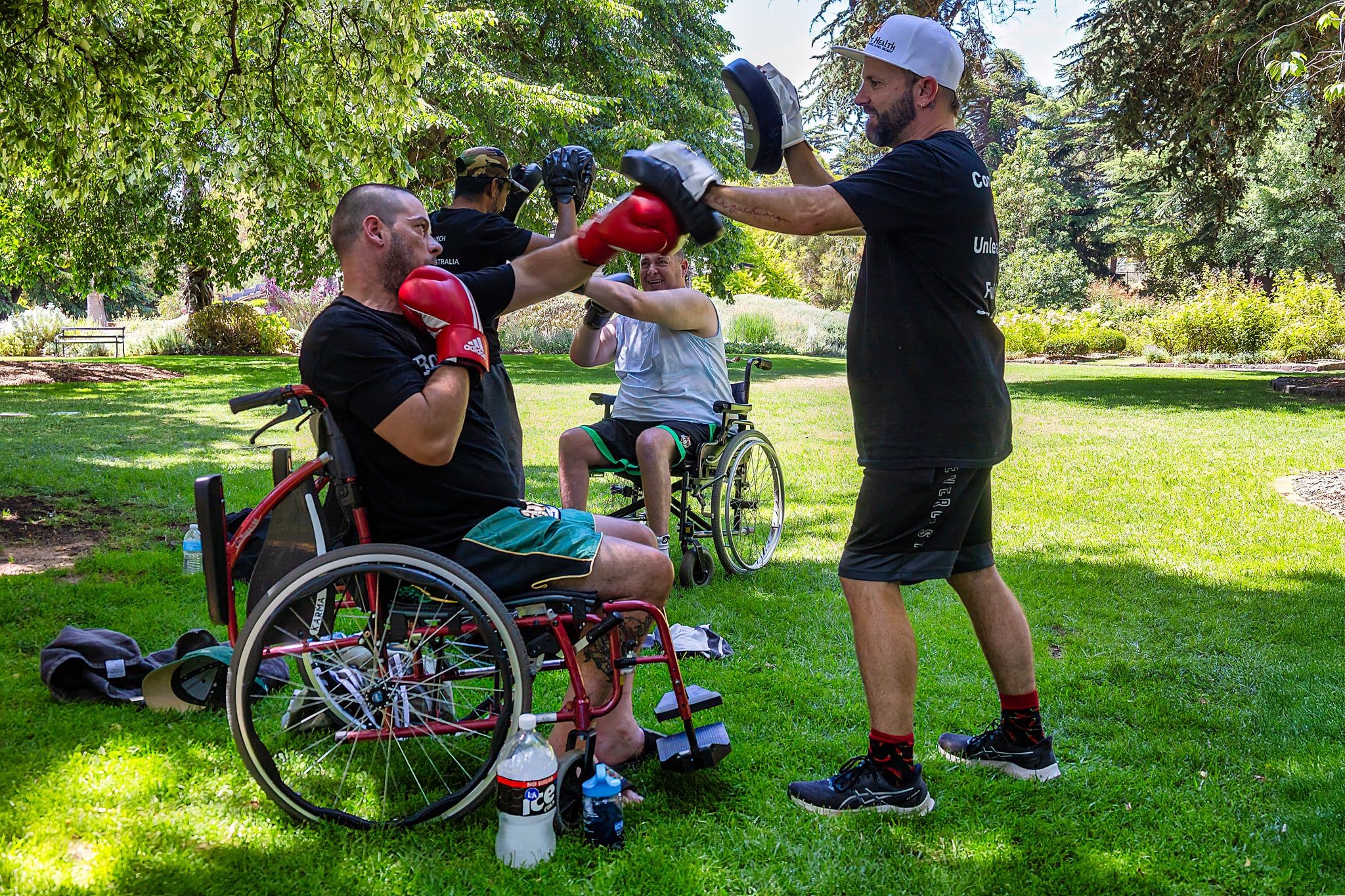
Luke Harrison became Phil’s support worker in 2024, when Phil first showed interest in boxing. During his physio sessions, Phil had seen CHG’s free community health classes for physically and intellectually disabled people that combined boxing with mindfulness exercises. Though no one in the classes were in wheelchairs, Phil wanted to get involved. Luke said he didn’t have much boxing experience back then, but he became Phil’s coach and they “jumped straight into it”.
Working out on the focus mitts with Luke up to four times a week in the classes gave Phil meaning, purpose – and fitness – that he’d never had. His strength, power and skill all grew and soon he wanted to test himself in the ring. With Luke and CHG’s support, bouts were set up but later postponed as a string of opponents pulled out. He did some sparring in front of a crowd but, in early 2026, Luke and Phil heard about Eddie Buttimore’s desire to get in the ring.
“Danny Green versus Mundine. Or Mike Tyson and Muhammad Ali. Think of those guys and you’ll have a rough idea,” Phil laughed when I asked him about his fight plan for Eddie. But, jokes aside, he said he was looking forward to meeting Eddie and going out to dinner with him.
“For nine minutes they’ll be opponents, but the rest of the time… they’ll just be two guys that share a passion.”
— Luke Harrison, coach
There’s no doubt about Eddie’s passion for boxing. Able-bodied growing up, Eddie was raised in a family of pugilists and showed promise when he was younger, once fighting in front of a crowd of a few thousand.
“I had a spinal injury about twelve years ago,” he said on the phone from Brisbane before the fight, adding that he’d kept boxing in his wheelchair, often with the support of his wife and coach, Jasmine. “She’s a kickboxer and she – and my kids – are high up in martial arts.”
Like Phil, Eddie tried to set up fights, but nothing eventuated. So, in stepped Barry O’Keefe, who trains able-bodied and all-abilities boxers at Boxing Fit. Barry helped raise sponsorship dollars to bring Eddie to Melbourne and fulfil his fighting dream.
“I’m absolutely excited,” Eddie said in the weeks before the fight. “Everyone deserves a shot, a chance to try something and not be judged.”
He meant, of course, being judged for living with a disability. Because tonight, three ringside judges are scoring his contest with Phil. As round two gets underway, it’s clear the judges will have a challenge on their hands to decide which of these brave fighters is landing the cleaner blows. But the first and biggest challenge for Australian boxers with a disability is tonight being conquered: a public exhibition bout between two quality and evenly matched fighters. The newly formed Australian Adaptive Boxing Council (AABC) hopes tonight will be a beachhead for the sport, which is virtually unknown in Australia.
A young sport finding its feet
People with a disabilityhave participated globally in many sports for decades, but adaptive boxing has a short history. Origin stories are debated, but it’s likely the first bout took place in 2015, when wheelchair fighters Paul Robinson and Phil Bousfield took to the ring in a London nightclub. That bout came off the back of the work of Englishman Colin Wood, a vision-impaired former rugby coach, who had in 2014 founded the World Adaptive Boxing Council (WABC) in London.
In the more than a decade since, the sport has gathered momentum, particularly in the UK, Canada and the United States, and international competitions have been held around the world. Those supporting and competing in adaptive boxing are now pushing for Paralympic status, but to achieve that it must be widely practiced in 32 countries across four continents.
“There’s still much to do,” said Alec Pritchard, a world-leading adaptive boxing coach with USA-based DPI Adaptive Fitness Gym, an organisation with close links to the nation’s United Adaptive Boxing Council (UABC). “The key to the sport’s acceptance into the Paralympics will be gyms and adaptive boxers around the world understanding there is a competitive avenue for them.”
Australian people with a disability have been doing supervised boxing training, whether in wheelchairs or not, for many years. Trainers use focus mitts and bags; it’s non-contact and builds fitness – and the positive impact on people’s lives has been significant.
“You get the cardiovascular thing, the strength work, but you’re working both sides of your brain, which helps with mental clarity,” said Barry O’Keefe, a trainer of all abilities and mainstream boxers at Boxing Fit. Pritchard agreed, saying boxing skills helped improve his participants’ hand-eye coordination and reaction time. And then there were the positive benefits of being part of the boxing fraternity. “Adaptive boxers belong to a community of other boxers and coaches who are cheering them on. Participants see a significant increase in their self-confidence as they learn new skills, set goals – and surpass those goals.”
In Australia, there has up until now been no governing body for the sport and little exposure, so it’s proven difficult to find match ups. After so many attempts on Phil’s behalf, Luke Harrison was thrilled when the bout with Eddie was finally confirmed. But, in the process of helping to lock it down, he found there were more adaptive fighters in Australia than he or anyone knew – and many wanted to get in the ring.
“I realised that it was going to be hard without an overarching body. And I also realised that, if anything was going to happen, it was probably going to be up to me!” Luke laughed.
In a process he described as “shoelacing it”, he established the Australian Adaptive Boxing Council (AABC) this year, along with Barry O’Keefe and Catherine Hutchison from Boxing Fit, and Troy Koerntjes from Complete Health Geelong. The organisation has no funding, but no less a figure than the legendary Jeff Fenech, four-time boxing world champion, is now the AABC’s ambassador. Fenech said that prior to becoming involved he’d seen clips of international adaptive boxing and he was pleased Australian fighters would now have their chance.
“I couldn’t imagine how proud these guys are to get out there and compete when nobody has given them the chance,” he said a few weeks before Phil and Eddie’s fight. “These guys are such inspirations to everybody because you look at them and you think, ‘Wow, they’re doing what they’re doing – and we have so many people overweight!’ These guys can’t walk or run, but they’re still at it; they’re competing, trying to do their best.”
For Fenech, the key to the sport gaining traction in Australia – and even pushing for Paralympic status – comes down to fighter safety. “I’m two hundred percent there for it as long as we’ve got good rules for safety because the most important thing is the safety of these young athletes,” Fenech said.
Safety in the ropes
Phil and Eddie’s fightshifts into round two, both boxers firing punches at a relentless pace, but their safety is paramount. The AABC is aware some people would be against disabled competitors wanting to do anything that risks their physical health. That’s why the fighters are in headgear, wearing heavily padded gloves, and are securely strapped into their chairs. And the boxers’ safety is boosted by ringside doctors – and their coaches and the referee inside the ropes – monitoring their welfare.
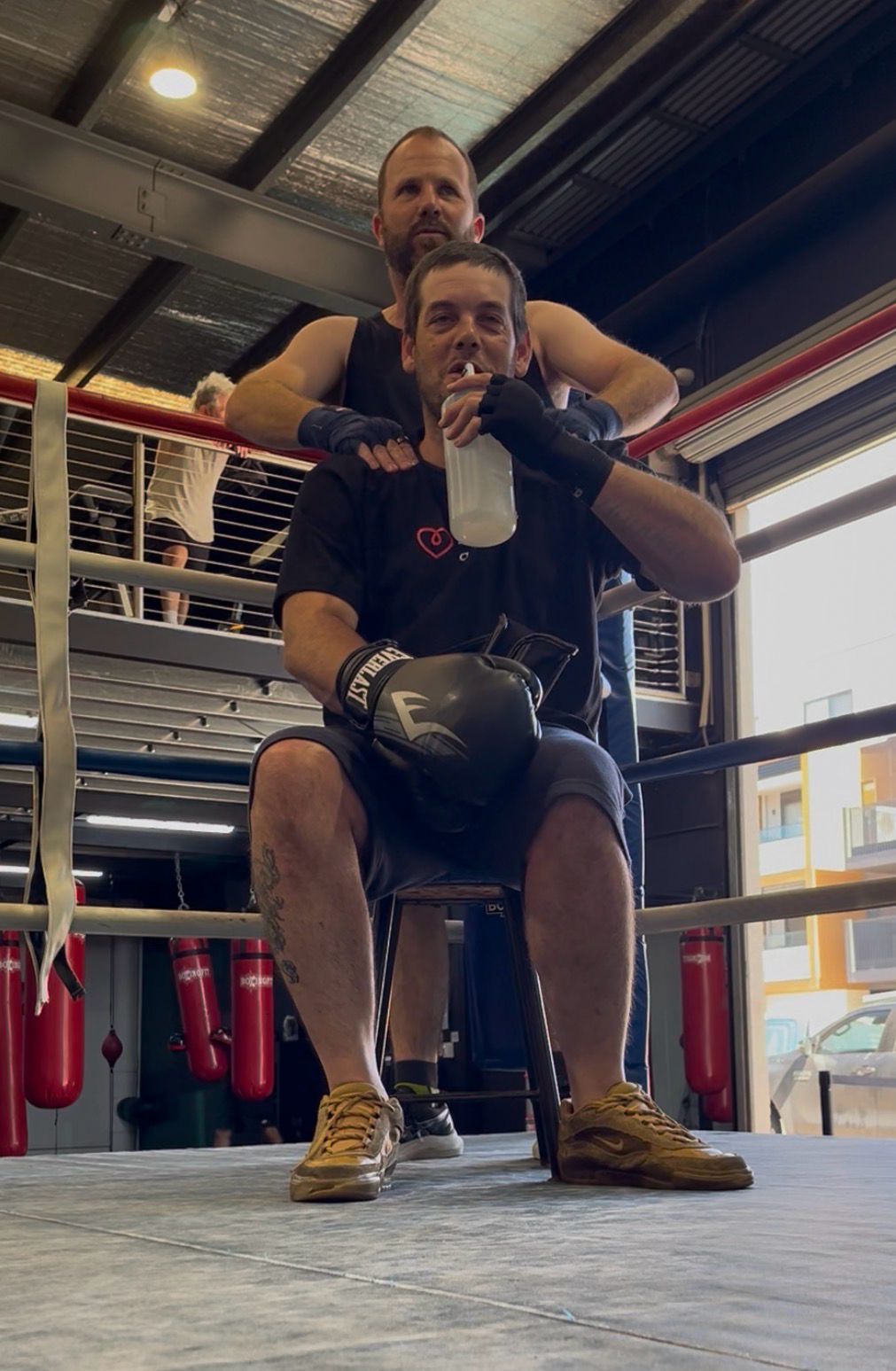
As the AABC presides over more fights, it will be responsible for developing in Australia all the regulations needed for the safest possible competition. In this, it will take cues from international organisations, including America’s UABC.
“Before getting into the ring, boxers spend considerable time learning boxing fundamentals, which include being defensive,” Alec Pritchard said of the US experience. “Think of this as your traditional rolling and slipping to avoid punches, and having our boxers focus on always protecting their head.”
He said that, once in the ring, boxers had to spar and fight with USA Boxing-certified headgear for protection and that certified referees oversaw all sanctioned match ups.
“UABC-sanctioned fights also require fighters’ wheelchairs to be secured to a platform in the ring to reduce, to near zero, the chance an adaptive boxer and their wheelchair will tip over.”
The platforms are something the AABC will consider introducing, but Luke said before the fight that he’d expect coaches in the ring would remain part of the sport’s future.
“Having the coaches there is important because we’re able to say he’s below his best or he’s injured because we know their physical situation so well.”
Regardless of all precautions, it’s clear Australian adaptive boxing will have its challenges. Contact sports worldwide are dealing with potentially huge legal suits to redress head trauma and calls have grown to ban any kind of boxing. The Australian Medical Association (AMA) wants it banned at Olympic and Commonwealth Games level, which appears a roadblock to Australian competitors helping in adaptive boxing’s push for Paralympic status.
Not all experts, however, agree with a ban. James Donnelly, Lecturer in Psychology at Southern Cross University, wrote in The Conversation about a Victorian study that had shown that “[a]fter controlling for the number of participants in each sport, motor sports, fishing, equestrian activities and swimming all led to more deaths in a year than boxing, which didn’t even make it into the top ten”.
Donnelly added that when a sport’s safety is evaluated, the full range of injuries they could cause should be considered, not only fatalities. “Major traumatic injuries, frequently to the head and face, are also much more common in motor sports, cycling, skiing, hockey and equestrian activities than in boxing.”
He wrote that, rather than a ban, the sport’s risk factors could be better managed.
“This may decrease the brutality that attracts some people to the sport, but it will increase the opportunities for life after it for those risking life and limb by participating.”
Giving more than you take
Eddie and Phil agreedthat the risk to their limbs that still work optimally was worth it to be in the ring. With round three action underway, both fighters are tiring despite their weeks of training. Eddie looks for body punches then protects his head, while Phil leans back and picks his shots. The boxers have different styles when knee to knee, and it’s the same when taken to the sides: Eddie tries more overhand shots as Phil uses his core strength to sway and fire back.
There’s a life adage that comes from boxing: you have to give more than you take. Phil said the sport had given him more than he could have imagined. “I’m able to move around at home much more than I could previously.”
Luke said boxing had increased Phil’s confidence, done wonders for the depression he’d experienced, and greatly improved his general motivation.
“When we first started working together, it was hit and miss whether he’d show up to the gym. He’d be asleep when I drove over to get him. But, when he started boxing…”
Here, Phil interjected: “Seven o’clock, I’m in the shower and then I’m out in the garage with the door open, waiting for the coach!”
For Eddie, keeping on boxing from his wheelchair – and now fighting competitively – has kept up his fitness and sense of purpose.
“People don’t have to go down the competitive avenue,” he said, “but you can chuck on a pair of gloves, meet new people. When you leave hospital, there’s kind of nothing to look forward to. There’s wheelchair basketball and other sports – but they’re not for everyone.”
The final bell rings and the boxers get whoops of approval from the crowd. While other exhibition fights on the card tonight were, as is traditional, scored draws, Phil and Eddie wanted their bout to have a result. Tonight’s close win goes to Eddie, but it’s obvious from the smiles on both fighters’ faces that there’s another clear winner.
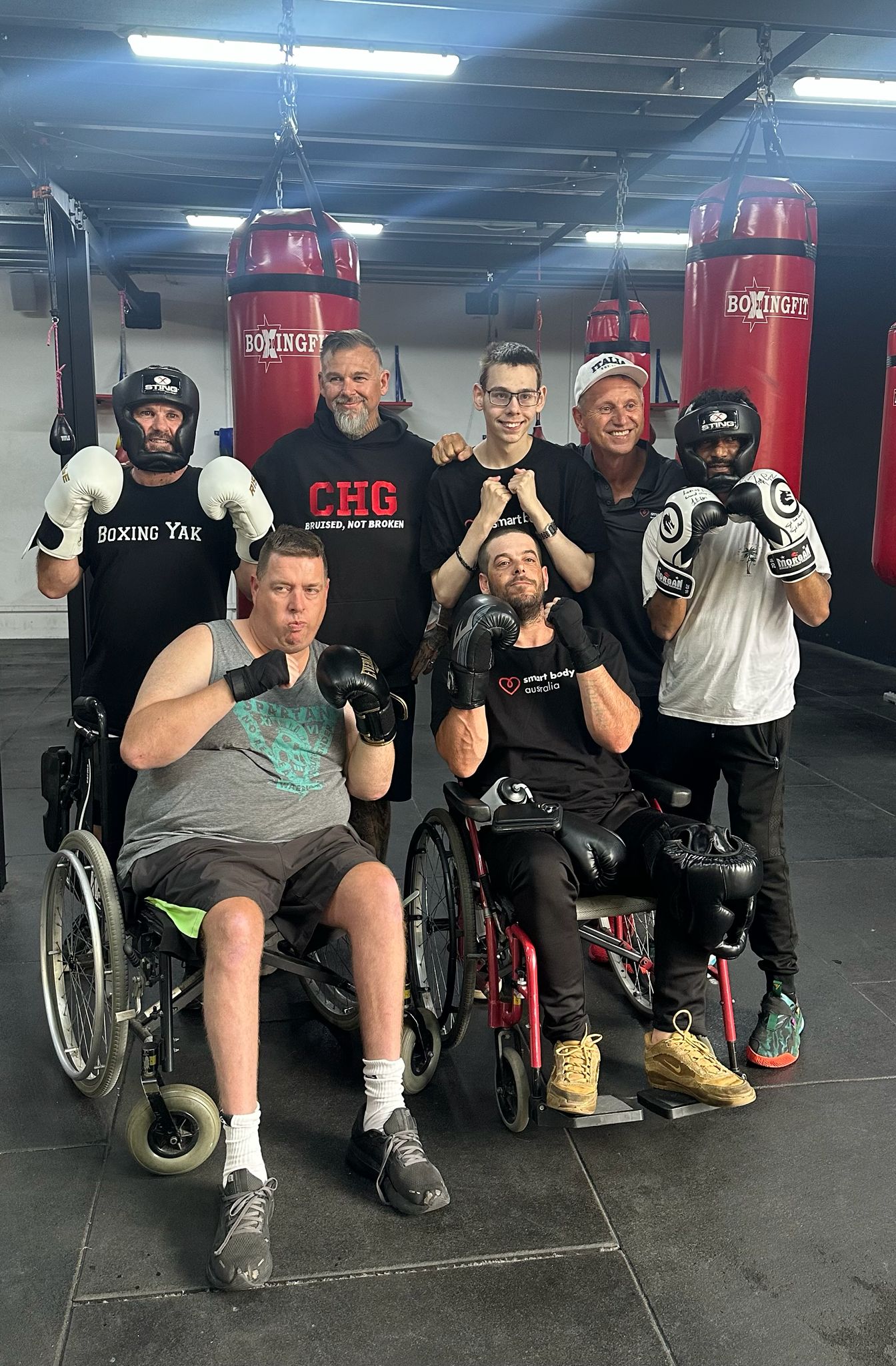
“It’s been nearly 20 years since I last competed,” Eddie said after the fight, “and the support was amazing. It was absolutely amazing to box again in front of a crowd!”
Phil agreed that hearing the crowd cheer was the best part of the night. “I loved it. Because wheelchair boxing is so new, I think people are only just starting to realise how exciting it can be. The support means a lot – I’m grateful to everyone helping grow the sport.”
Barry O’Keefe said the AABC is planning on doing just that: one of its first aims is to host a fight card consisting of only adaptive boxing bouts.
“They won’t have to be in a wheelchair as such,” he said, adding that AABC will seek fitness and competition boxing opportunities on as big a scale as possible. “They might have a leg injury or a mental illness. Whatever the case may be our motto is that we’re going to include the unincluded.”
By Paul Mitchell, a Melbourne-based freelance journalist and author. Edited versions of this article appeared in LINK magazine and The Big Issue in 2026.